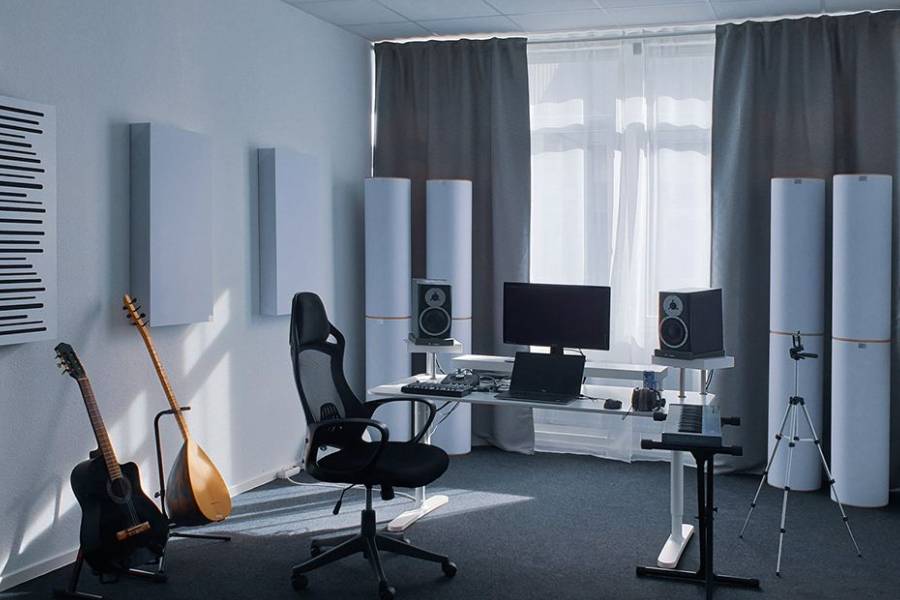
Weak home audio isn’t always a speaker-quality problem. A capable system can sound thin, muddy, harsh, or strangely unbalanced when speakers are pushed into corners, blocked by furniture, placed at different distances, or aimed away from the main listening position.
Before buying new equipment, experiment with placement. It costs nothing and can make a surprisingly large difference.
Give Speakers Space to Work
Placing speakers directly against a wall can increase some bass frequencies while making the overall response less balanced. Corners may exaggerate the effect because several room boundaries meet in one place.
Try moving the speakers forward in small increments and listen again. You aren’t searching for a universal measurement; you’re finding the position that works with your room, furniture, and listening distance.
Homeowners exploring living-space ideas may also notice that furniture layout and audio placement often need to be planned together rather than separately.
Aim the Speakers Toward the Listening Area
Stereo speakers usually perform better when the listener isn’t dramatically closer to one speaker than the other. A reasonably balanced layout helps vocals and instruments appear more naturally between the speakers.
Experiment with the angle too. Slightly turning speakers toward the main seat can improve clarity in some rooms, while excessive toe-in can make the sound feel narrow or overly direct.
Ideas from home entertainment reading can be useful inspiration, but listening tests in your own room matter more than copying someone else’s exact setup.
| Sound Problem | Possible Placement Cause | Adjustment to Try |
|---|---|---|
| Thin bass | Speaker location cancels bass | Move forward/backward |
| Boomy bass | Too close to corner | Increase corner distance |
| Weak center image | Uneven speaker geometry | Balance positioning |
| Dull detail | Speakers poorly aimed | Adjust listening angle |
Don’t Ignore the Listening Position
Moving the sofa can change sound almost as much as moving the speakers. Certain positions may emphasize or reduce particular bass frequencies because sound waves interact with the room boundaries.
If possible, avoid placing the main listening seat tightly against the rear wall. Even moving it a modest distance can change bass balance and improve separation.
Broader interior technology topics can provide setup concepts, but every room behaves differently because dimensions, surfaces, furnishings, and openings change how sound reflects.
Control Reflections Without Deadening the Room
Hard floors, bare walls, large windows, and other reflective surfaces can make sound brighter or more confused. Curtains, rugs, upholstered furniture, bookshelves, and other normal furnishings can sometimes reduce excessive reflections without turning the room into a recording studio.
Don’t assume more absorption is automatically better. A room with too many soft materials can become unnaturally dull, so changes should be made gradually and judged by listening.
Where Audio Upgrades Commonly Go Wrong
Replacing speakers before testing placement can produce an expensive version of the same problem. New equipment still interacts with the same walls, corners, seating position, and reflective surfaces.
Another mistake is copying placement dimensions from another room as if they were universal. Speaker design and room geometry vary. Use recommendations as starting points, then move one element at a time so you can hear what actually changed.
Frequently Asked Questions
How far should speakers be from the wall?
There is no single distance that works for every speaker and room. Start with the manufacturer’s recommendations when available, then make small placement changes while listening for improvements in bass balance and clarity.
Should speakers point directly at the listener?
Sometimes. Slight toe-in can improve focus and imaging, but the best angle depends on the speaker’s dispersion and room. Compare straight-ahead positioning with gradual inward angles rather than assuming one setup is correct.
Can moving a sofa improve home audio?
Yes. The listening position affects how direct and reflected sound reaches your ears, particularly at lower frequencies. Even a moderate change in seating location can alter bass response and stereo balance.
Adjust the Room Before Replacing the System
Treat placement as part of the audio system rather than an afterthought. Move speakers, adjust their angle, test the listening position, and control strong reflections one change at a time. If the sound improves, you’ve learned what the room needs—and you can make any later equipment upgrade with much better information.